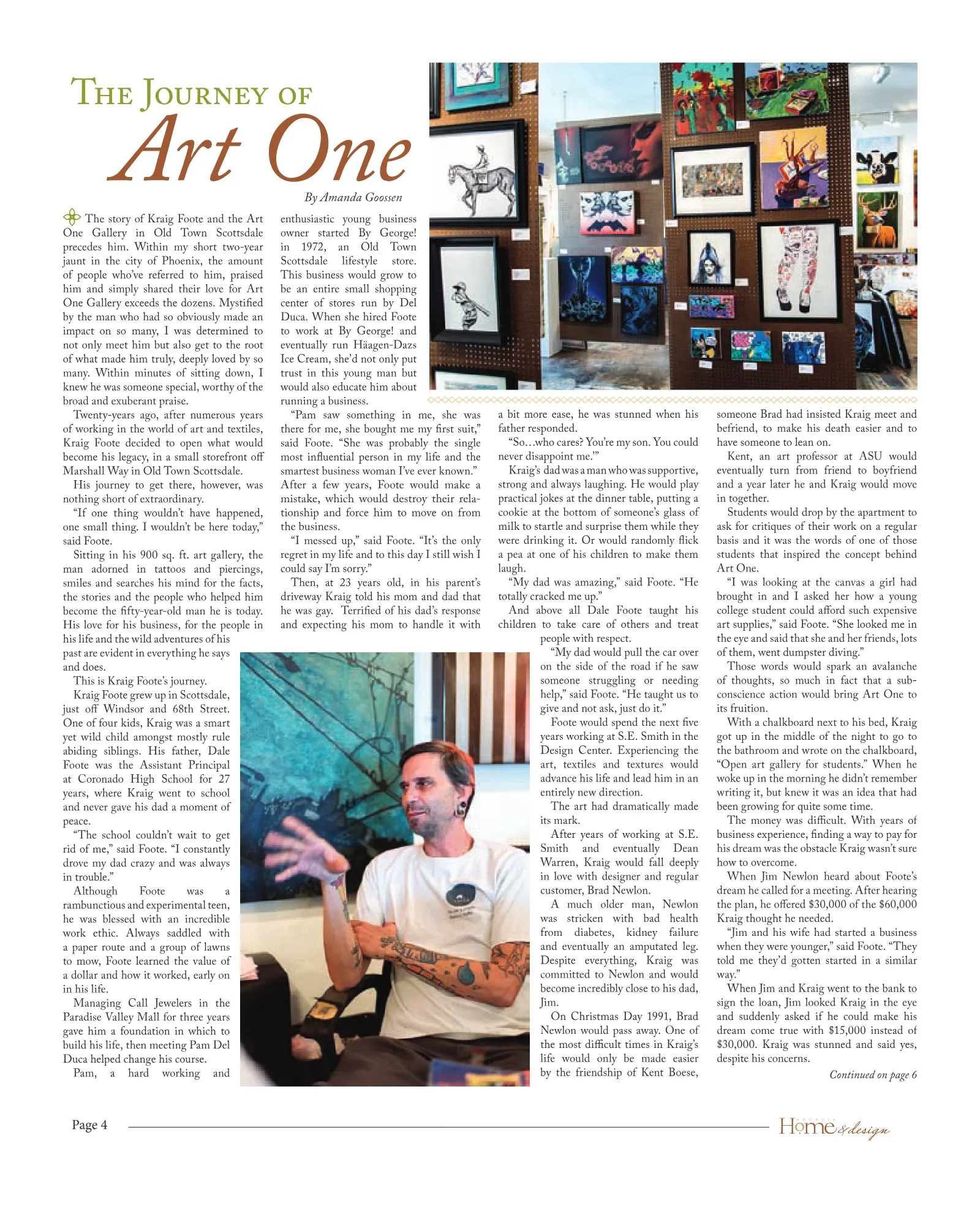

Page 4 The story of Kraig Foote and the Art One Gallery in Old Town Scottsdale precedes him. Within my short two-year jaunt in the city of Phoenix, the amount of people who’ve referred to him, praised him and simply shared their love for Art One Gallery exceeds the dozens. Mystified by the man who had so obviously made an impact on so many, I was determined to not only meet him but also get to the root of what made him truly, deeply loved by so many. Within minutes of sitting down, I knew he was someone special, worthy of the broad and exuberant praise. Twenty-years ago, after numerous years of working in the world of art and textiles, Kraig Foote decided to open what would become his legacy, in a small storefront off Marshall Way in Old Town Scottsdale. His journey to get there, however, was nothing short of extraordinary. “If one thing wouldn’t have happened, one small thing. I wouldn’t be here today,” said Foote. Sitting in his 900 sq. ft. art gallery, the man adorned in tattoos and piercings, smiles and searches his mind for the facts, the stories and the people who helped him become the fifty-year-old man he is today. His love for his business, for the people in his life and the wild adventures of his past are evident in everything he says and does. This is Kraig Foote’s journey. Kraig Foote grew up in Scottsdale, just off Windsor and 68th Street. One of four kids, Kraig was a smart yet wild child amongst mostly rule abiding siblings. His father, Dale Foote was the Assistant Principal at Coronado High School for 27 years, where Kraig went to school and never gave his dad a moment of peace. “The school couldn’t wait to get rid of me,” said Foote. “I constantly drove my dad crazy and was always in trouble.” Although Foote was a rambunctious and experimental teen, he was blessed with an incredible work ethic. Always saddled with a paper route and a group of lawns to mow, Foote learned the value of a dollar and how it worked, early on in his life. Managing Call Jewelers in the Paradise Valley Mall for three years gave him a foundation in which to build his life, then meeting Pam Del Duca helped change his course. Pam, a hard working and enthusiastic young business owner started By George! in 1972, an Old Town Scottsdale lifestyle store. This business would grow to be an entire small shopping center of stores run by Del Duca. When she hired Foote to work at By George! and eventually run Häagen-Dazs Ice Cream, she’d not only put trust in this young man but would also educate him about running a business. “Pam saw something in me, she was there for me, she bought me my first suit,” said Foote. “She was probably the single most influential person in my life and the smartest business woman I’ve ever known.” After a few years, Foote would make a mistake, which would destroy their rela- tionship and force him to move on from the business. “I messed up,” said Foote. “It’s the only regret in my life and to this day I still wish I could say I’m sorry.” Then, at 23 years old, in his parent’s driveway Kraig told his mom and dad that he was gay. Terrified of his dad’s response and expecting his mom to handle it with a bit more ease, he was stunned when his father responded. “So…who cares? You’re my son. You could never disappoint me.’” Kraig’s dad was a man who was supportive, strong and always laughing. He would play practical jokes at the dinner table, putting a cookie at the bottom of someone’s glass of milk to startle and surprise them while they were drinking it. Or would randomly flick a pea at one of his children to make them laugh. “My dad was amazing,” said Foote. “He totally cracked me up.” And above all Dale Foote taught his children to take care of others and treat people with respect. “My dad would pull the car over on the side of the road if he saw someone struggling or needing help,” said Foote. “He taught us to give and not ask, just do it.” Foote would spend the next five years working at S.E. Smith in the Design Center. Experiencing the art, textiles and textures would advance his life and lead him in an entirely new direction. The art had dramatically made its mark. After years of working at S.E. Smith and eventually Dean Warren, Kraig would fall deeply in love with designer and regular customer, Brad Newlon. A much older man, Newlon was stricken with bad health from diabetes, kidney failure and eventually an amputated leg. Despite everything, Kraig was committed to Newlon and would become incredibly close to his dad, Jim. On Christmas Day 1991, Brad Newlon would pass away. One of the most difficult times in Kraig’s life would only be made easier by the friendship of Kent Boese, someone Brad had insisted Kraig meet and befriend, to make his death easier and to have someone to lean on. Kent, an art professor at ASU would eventually turn from friend to boyfriend and a year later he and Kraig would move in together. Students would drop by the apartment to ask for critiques of their work on a regular basis and it was the words of one of those students that inspired the concept behind Art One. “I was looking at the canvas a girl had brought in and I asked her how a young college student could afford such expensive art supplies,” said Foote. “She looked me in the eye and said that she and her friends, lots of them, went dumpster diving.” Those words would spark an avalanche of thoughts, so much in fact that a sub- conscience action would bring Art One to its fruition. With a chalkboard next to his bed, Kraig got up in the middle of the night to go to the bathroom and wrote on the chalkboard, “Open art gallery for students.” When he woke up in the morning he didn’t remember writing it, but knew it was an idea that had been growing for quite some time. The money was difficult. With years of business experience, finding a way to pay for his dream was the obstacle Kraig wasn’t sure how to overcome. When Jim Newlon heard about Foote’s dream he called for a meeting. After hearing the plan, he offered $30,000 of the $60,000 Kraig thought he needed. “Jim and his wife had started a business when they were younger,” said Foote. “They told me they’d gotten started in a similar way.” When Jim and Kraig went to the bank to sign the loan, Jim looked Kraig in the eye and suddenly asked if he could make his dream come true with $15,000 instead of $30,000. Kraig was stunned and said yes, despite his concerns. Continued on page 6 The Journey of Art One By Amanda Goossen