
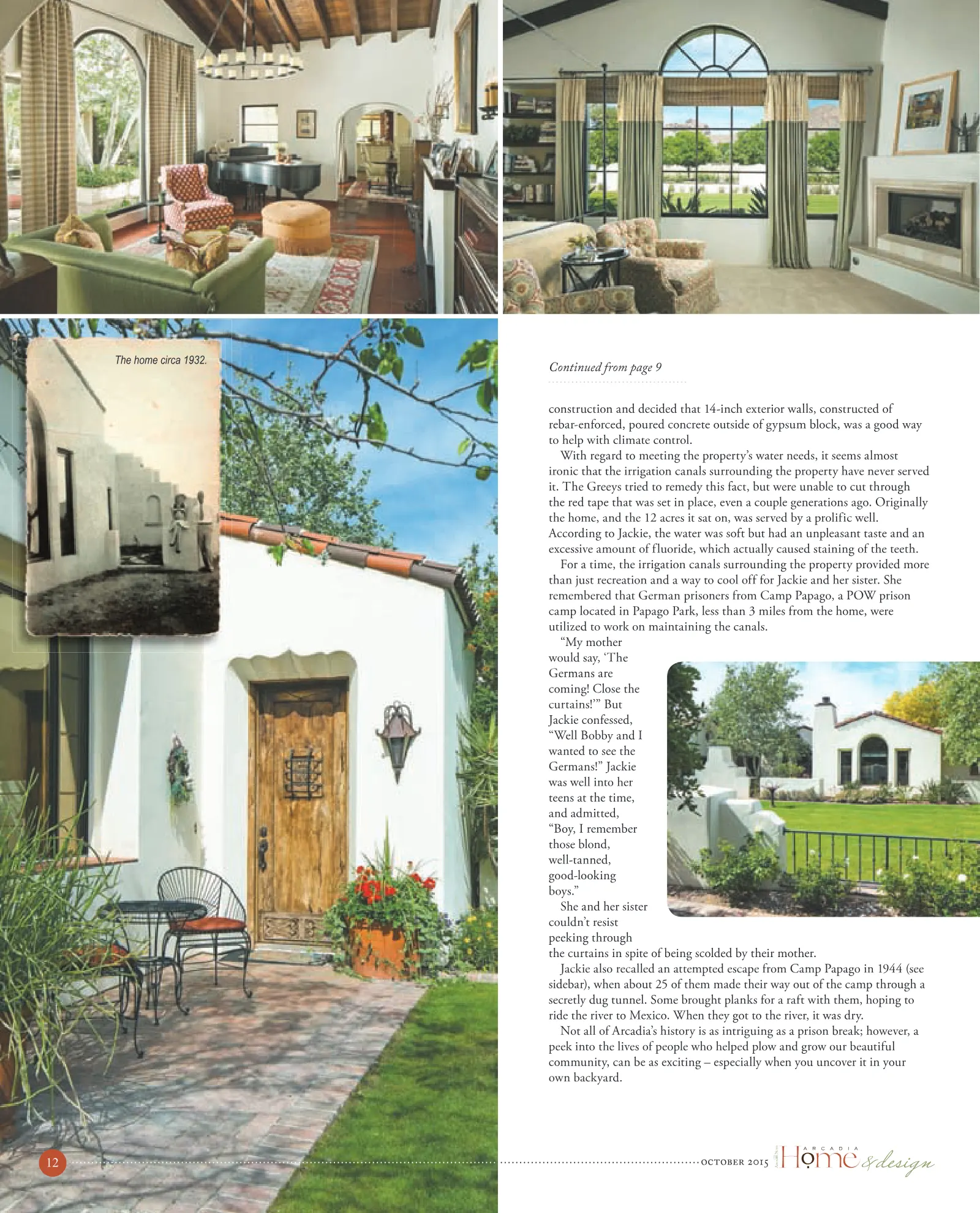
12 october 2015 Continued from page 9 construction and decided that 14-inch exterior walls, constructed of rebar-enforced, poured concrete outside of gypsum block, was a good way to help with climate control. With regard to meeting the property’s water needs, it seems almost ironic that the irrigation canals surrounding the property have never served it. The Greeys tried to remedy this fact, but were unable to cut through the red tape that was set in place, even a couple generations ago. Originally the home, and the 12 acres it sat on, was served by a prolific well. According to Jackie, the water was soft but had an unpleasant taste and an excessive amount of fluoride, which actually caused staining of the teeth. For a time, the irrigation canals surrounding the property provided more than just recreation and a way to cool off for Jackie and her sister. She remembered that German prisoners from Camp Papago, a POW prison camp located in Papago Park, less than 3 miles from the home, were utilized to work on maintaining the canals. “My mother would say, ‘The Germans are coming! Close the curtains!’” But Jackie confessed, “Well Bobby and I wanted to see the Germans!” Jackie was well into her teens at the time, and admitted, “Boy, I remember those blond, well-tanned, good-looking boys.” She and her sister couldn’t resist peeking through the curtains in spite of being scolded by their mother. Jackie also recalled an attempted escape from Camp Papago in 1944 (see sidebar), when about 25 of them made their way out of the camp through a secretly dug tunnel. Some brought planks for a raft with them, hoping to ride the river to Mexico. When they got to the river, it was dry. Not all of Arcadia’s history is as intriguing as a prison break; however, a peek into the lives of people who helped plow and grow our beautiful community, can be as exciting – especially when you uncover it in your own backyard. The home circa 1932.
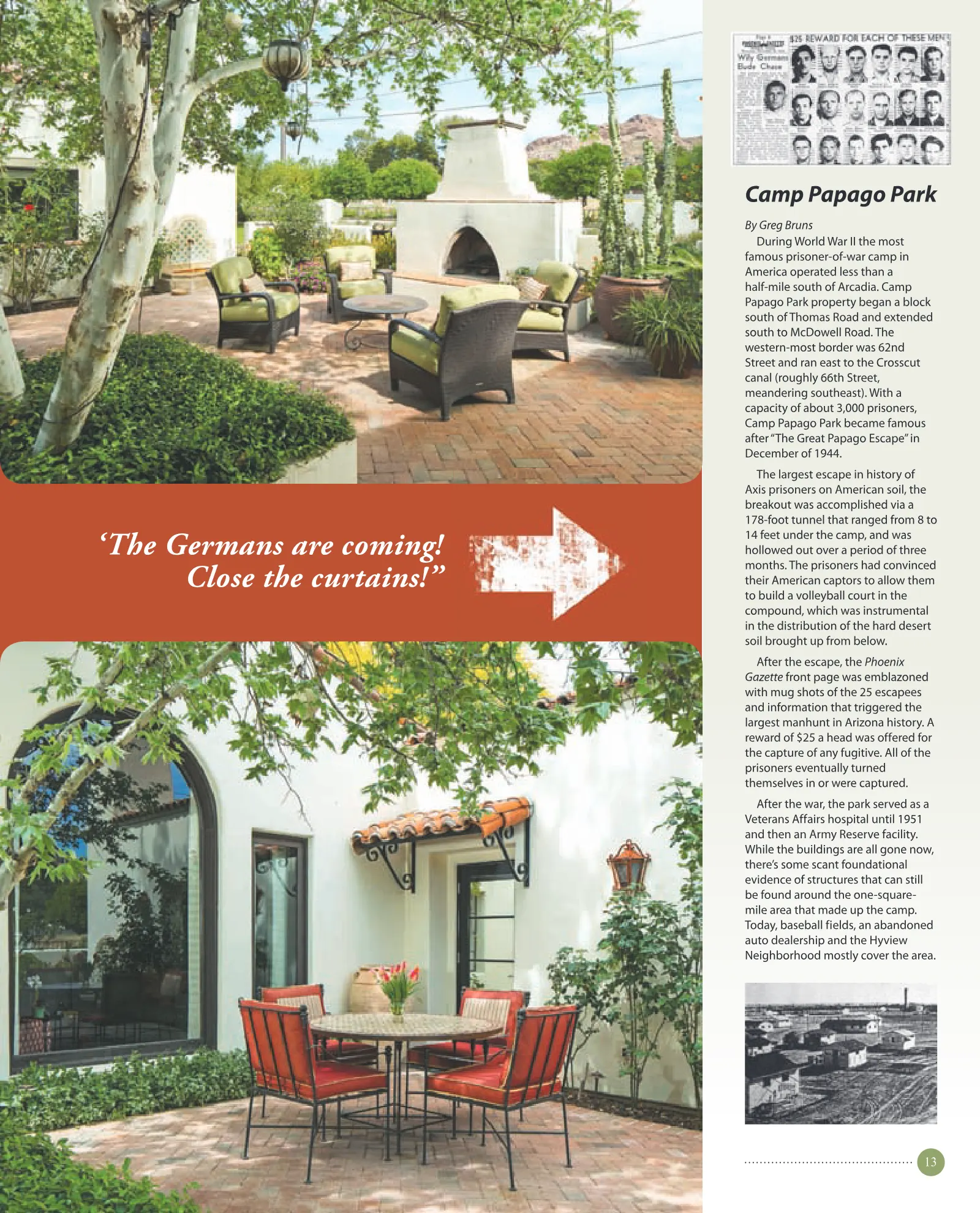
13 By Greg Bruns During World War II the most famous prisoner-of-war camp in America operated less than a half-mile south of Arcadia. Camp Papago Park property began a block south of Thomas Road and extended south to McDowell Road. The western-most border was 62nd Street and ran east to the Crosscut canal (roughly 66th Street, meandering southeast). With a capacity of about 3,000 prisoners, Camp Papago Park became famous after “The Great Papago Escape” in December of 1944. The largest escape in history of Axis prisoners on American soil, the breakout was accomplished via a 178-foot tunnel that ranged from 8 to 14 feet under the camp, and was hollowed out over a period of three months. The prisoners had convinced their American captors to allow them to build a volleyball court in the compound, which was instrumental in the distribution of the hard desert soil brought up from below. After the escape, the Phoenix Gazette front page was emblazoned with mug shots of the 25 escapees and information that triggered the largest manhunt in Arizona history. A reward of $25 a head was offered for the capture of any fugitive. All of the prisoners eventually turned themselves in or were captured. After the war, the park served as a Veterans Affairs hospital until 1951 and then an Army Reserve facility. While the buildings are all gone now, there’s some scant foundational evidence of structures that can still be found around the one-square- mile area that made up the camp. Today, baseball fields, an abandoned auto dealership and the Hyview Neighborhood mostly cover the area. ‘The Germans are coming! Close the curtains!” Camp Papago Park