
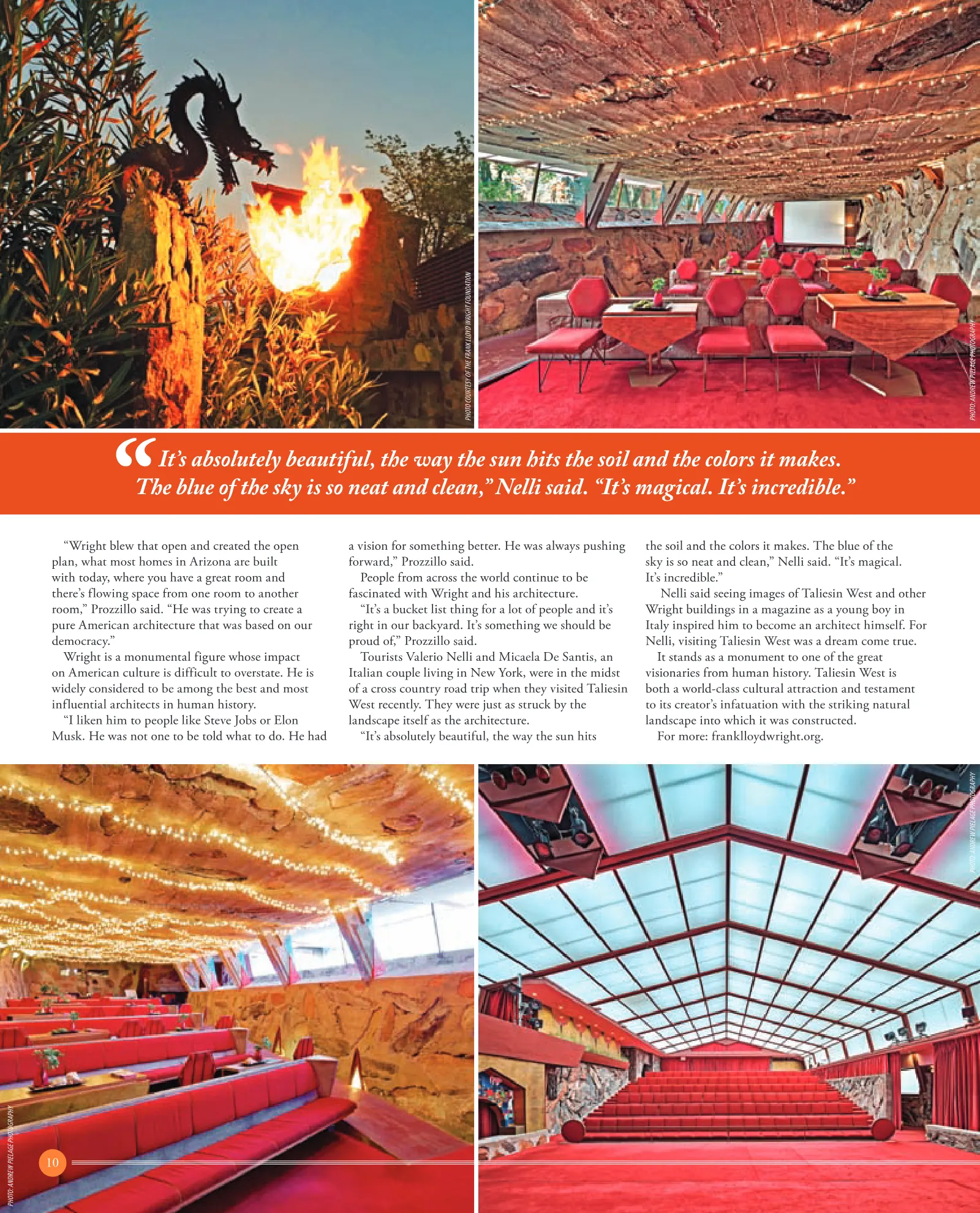
10 “Wright blew that open and created the open plan, what most homes in Arizona are built with today, where you have a great room and there’s flowing space from one room to another room,” Prozzillo said. “He was trying to create a pure American architecture that was based on our democracy.” Wright is a monumental figure whose impact on American culture is difficult to overstate. He is widely considered to be among the best and most influential architects in human history. “I liken him to people like Steve Jobs or Elon Musk. He was not one to be told what to do. He had a vision for something better. He was always pushing forward,” Prozzillo said. People from across the world continue to be fascinated with Wright and his architecture. “It’s a bucket list thing for a lot of people and it’s right in our backyard. It’s something we should be proud of,” Prozzillo said. Tourists Valerio Nelli and Micaela De Santis, an Italian couple living in New York, were in the midst of a cross country road trip when they visited Taliesin West recently. They were just as struck by the landscape itself as the architecture. “It’s absolutely beautiful, the way the sun hits the soil and the colors it makes. The blue of the sky is so neat and clean,” Nelli said. “It’s magical. It’s incredible.” Nelli said seeing images of Taliesin West and other Wright buildings in a magazine as a young boy in Italy inspired him to become an architect himself. For Nelli, visiting Taliesin West was a dream come true. It stands as a monument to one of the great visionaries from human history. Taliesin West is both a world-class cultural attraction and testament to its creator’s infatuation with the striking natural landscape into which it was constructed. For more: franklloydwright.org. It’s absolutely beautiful, the way the sun hits the soil and the colors it makes. The blue of the sky is so neat and clean,” Nelli said. “It’s magical. It’s incredible.” PHOTO: ANDREW PIELAGE PHOTOGRAPHY PHOTO COURTESY OF THE FRANK LLOYD WRIGHT FOUNDATION PHOTO: ANDREW PIELAGE PHOTOGRAPHY PHOTO: ANDREW PIELAGE PHOTOGRAPHY
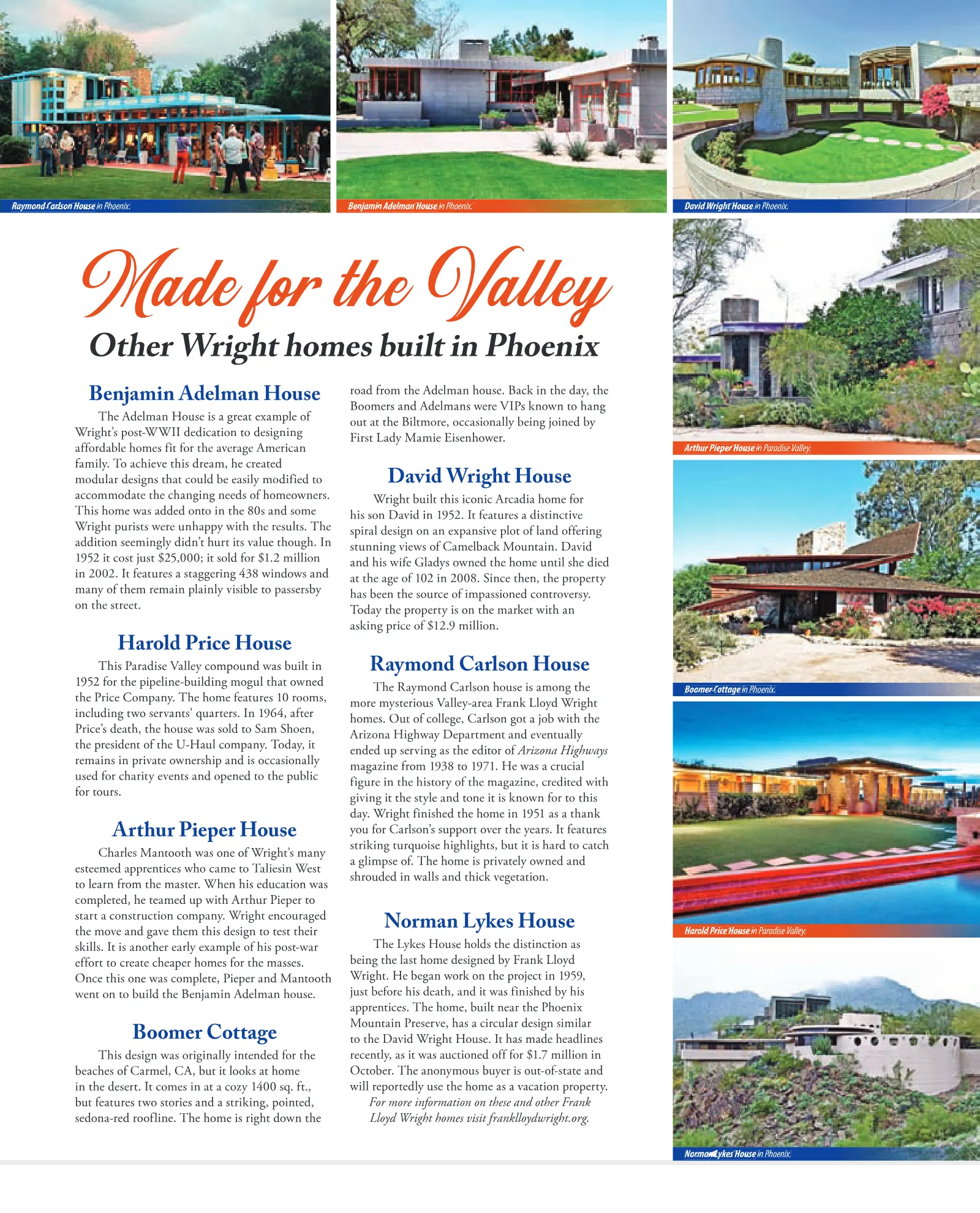
Benjamin Adelman House The Adelman House is a great example of Wright’s post-WWII dedication to designing affordable homes fit for the average American family. To achieve this dream, he created modular designs that could be easily modified to accommodate the changing needs of homeowners. This home was added onto in the 80s and some Wright purists were unhappy with the results. The addition seemingly didn’t hurt its value though. In 1952 it cost just $25,000; it sold for $1.2 million in 2002. It features a staggering 438 windows and many of them remain plainly visible to passersby on the street. Harold Price House This Paradise Valley compound was built in 1952 for the pipeline-building mogul that owned the Price Company. The home features 10 rooms, including two servants’ quarters. In 1964, after Price’s death, the house was sold to Sam Shoen, the president of the U-Haul company. Today, it remains in private ownership and is occasionally used for charity events and opened to the public for tours. Arthur Pieper House Charles Mantooth was one of Wright’s many esteemed apprentices who came to Taliesin West to learn from the master. When his education was completed, he teamed up with Arthur Pieper to start a construction company. Wright encouraged the move and gave them this design to test their skills. It is another early example of his post-war effort to create cheaper homes for the masses. Once this one was complete, Pieper and Mantooth went on to build the Benjamin Adelman house. Boomer Cottage This design was originally intended for the beaches of Carmel, CA, but it looks at home in the desert. It comes in at a cozy 1400 sq. ft., but features two stories and a striking, pointed, sedona-red roofline. The home is right down the road from the Adelman house. Back in the day, the Boomers and Adelmans were VIPs known to hang out at the Biltmore, occasionally being joined by First Lady Mamie Eisenhower. David Wright House Wright built this iconic Arcadia home for his son David in 1952. It features a distinctive spiral design on an expansive plot of land offering stunning views of Camelback Mountain. David and his wife Gladys owned the home until she died at the age of 102 in 2008. Since then, the property has been the source of impassioned controversy. Today the property is on the market with an asking price of $12.9 million. Raymond Carlson House The Raymond Carlson house is among the more mysterious Valley-area Frank Lloyd Wright homes. Out of college, Carlson got a job with the Arizona Highway Department and eventually ended up serving as the editor of Arizona Highways magazine from 1938 to 1971. He was a crucial figure in the history of the magazine, credited with giving it the style and tone it is known for to this day. Wright finished the home in 1951 as a thank you for Carlson’s support over the years. It features striking turquoise highlights, but it is hard to catch a glimpse of. The home is privately owned and shrouded in walls and thick vegetation. Norman Lykes House The Lykes House holds the distinction as being the last home designed by Frank Lloyd Wright. He began work on the project in 1959, just before his death, and it was finished by his apprentices. The home, built near the Phoenix Mountain Preserve, has a circular design similar to the David Wright House. It has made headlines recently, as it was auctioned off for $1.7 million in October. The anonymous buyer is out-of-state and will reportedly use the home as a vacation property. For more information on these and other Frank Lloyd Wright homes visit franklloydwright.org. Made for the Valley Other Wright homes built in Phoenix Raymond Carlson House in Phoenix. Benjamin Adelman House in Phoenix. David Wright House in Phoenix. Arthur Pieper House in Paradise Valley. Boomer Cottage in Phoenix. Harold Price House in Paradise Valley. Norman Lykes House in Phoenix.