
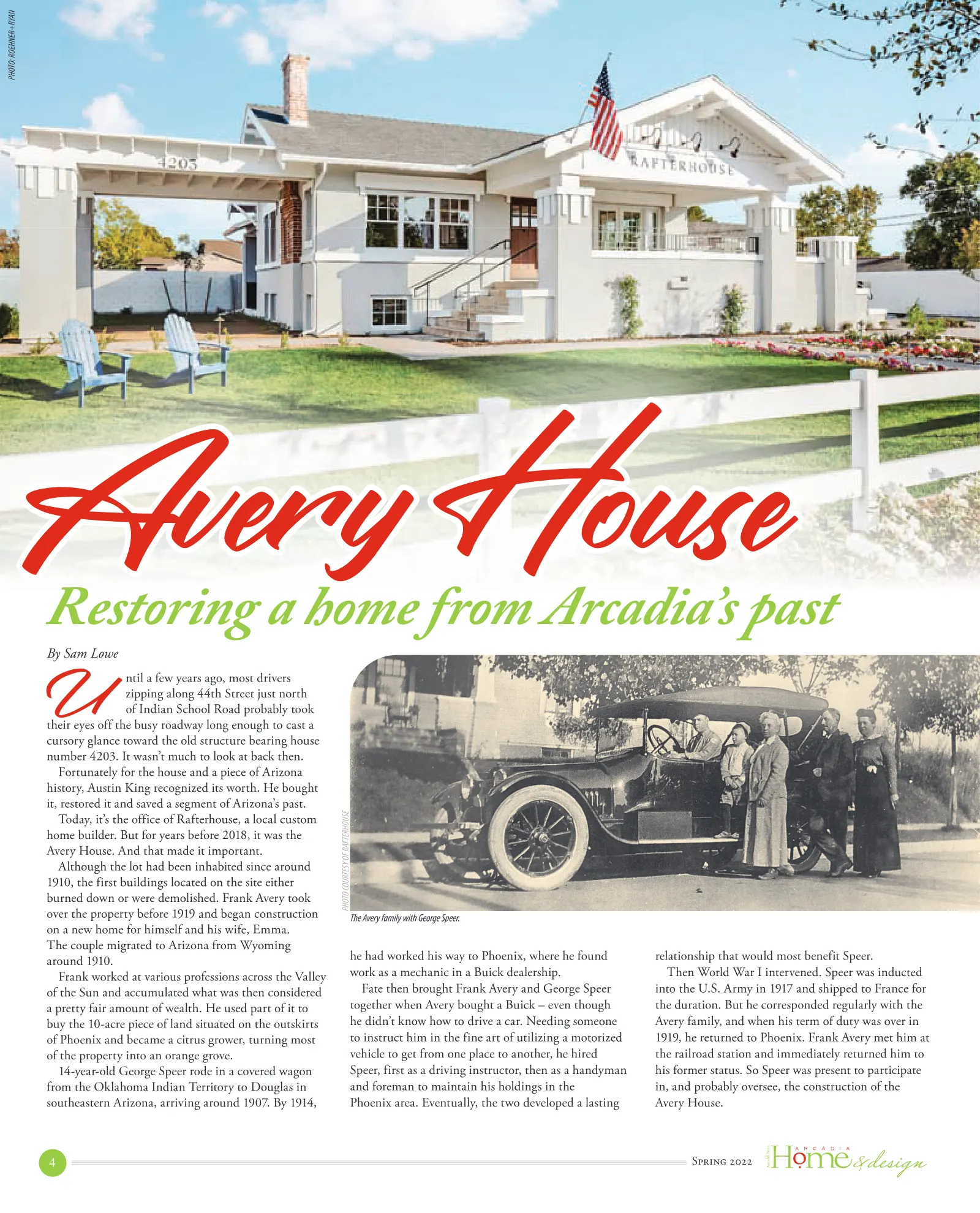
4 Spring 2022 Avery House By Sam Lowe U ntil a few years ago, most drivers zipping along 44th Street just north of Indian School Road probably took their eyes off the busy roadway long enough to cast a cursory glance toward the old structure bearing house number 4203. It wasn’t much to look at back then. Fortunately for the house and a piece of Arizona history, Austin King recognized its worth. He bought it, restored it and saved a segment of Arizona’s past. Today, it’s the office of Rafterhouse, a local custom home builder. But for years before 2018, it was the Avery House. And that made it important. Although the lot had been inhabited since around 1910, the first buildings located on the site either burned down or were demolished. Frank Avery took over the property before 1919 and began construction on a new home for himself and his wife, Emma. The couple migrated to Arizona from Wyoming around 1910. Frank worked at various professions across the Valley of the Sun and accumulated what was then considered a pretty fair amount of wealth. He used part of it to buy the 10-acre piece of land situated on the outskirts of Phoenix and became a citrus grower, turning most of the property into an orange grove. 14-year-old George Speer rode in a covered wagon from the Oklahoma Indian Territory to Douglas in southeastern Arizona, arriving around 1907. By 1914, he had worked his way to Phoenix, where he found work as a mechanic in a Buick dealership. Fate then brought Frank Avery and George Speer together when Avery bought a Buick – even though he didn’t know how to drive a car. Needing someone to instruct him in the fine art of utilizing a motorized vehicle to get from one place to another, he hired Speer, first as a driving instructor, then as a handyman and foreman to maintain his holdings in the Phoenix area. Eventually, the two developed a lasting relationship that would most benefit Speer. Then World War I intervened. Speer was inducted into the U.S. Army in 1917 and shipped to France for the duration. But he corresponded regularly with the Avery family, and when his term of duty was over in 1919, he returned to Phoenix. Frank Avery met him at the railroad station and immediately returned him to his former status. So Speer was present to participate in, and probably oversee, the construction of the Avery House. The Avery family with George Speer. PHOTO COURTESY OF RAFTERHOUSE PHOTO: ROEHNER+RYAN Restoring a home from Arcadia’s past
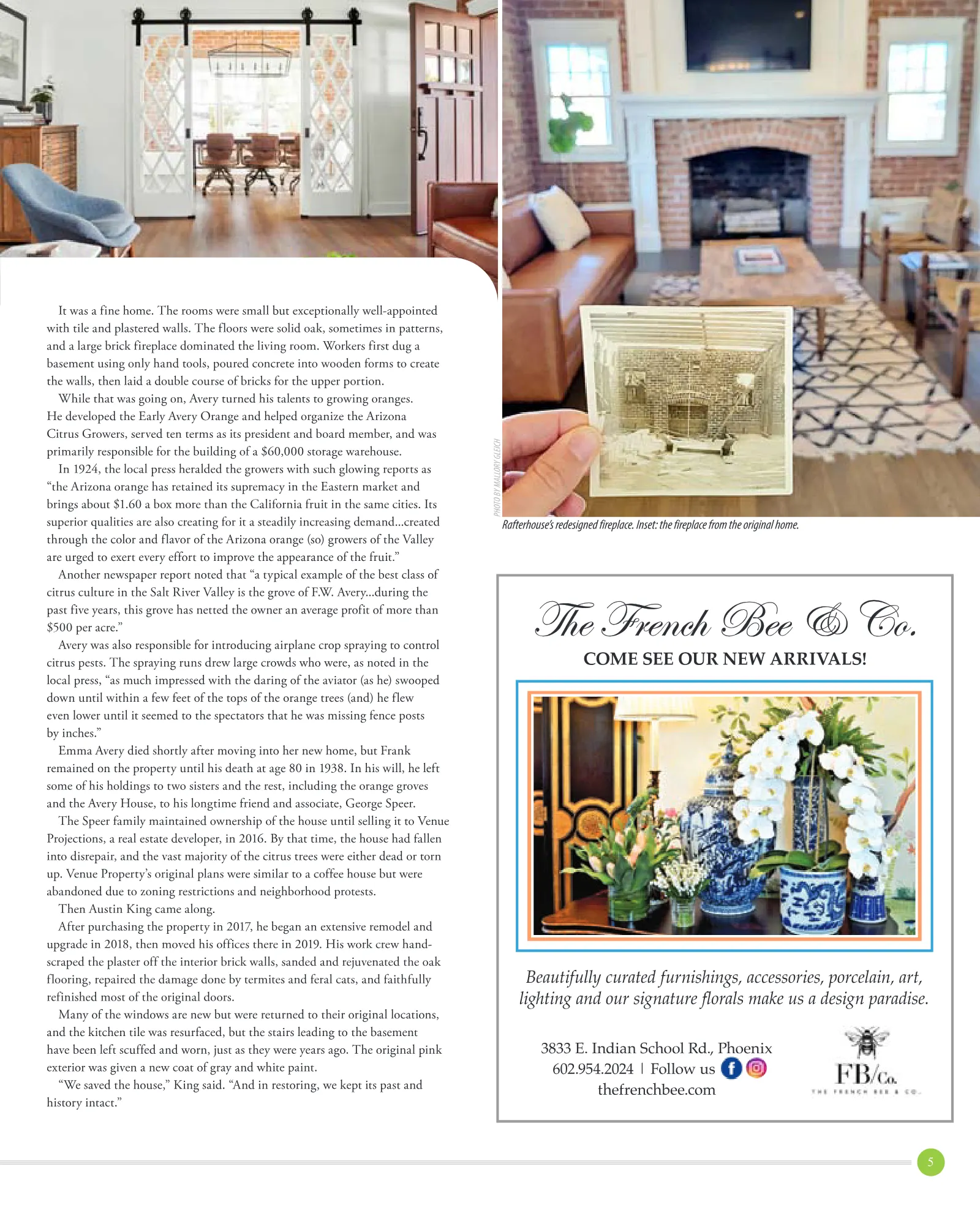
5 It was a fine home. The rooms were small but exceptionally well-appointed with tile and plastered walls. The floors were solid oak, sometimes in patterns, and a large brick fireplace dominated the living room. Workers first dug a basement using only hand tools, poured concrete into wooden forms to create the walls, then laid a double course of bricks for the upper portion. While that was going on, Avery turned his talents to growing oranges. He developed the Early Avery Orange and helped organize the Arizona Citrus Growers, served ten terms as its president and board member, and was primarily responsible for the building of a $60,000 storage warehouse. In 1924, the local press heralded the growers with such glowing reports as “the Arizona orange has retained its supremacy in the Eastern market and brings about $1.60 a box more than the California fruit in the same cities. Its superior qualities are also creating for it a steadily increasing demand...created through the color and flavor of the Arizona orange (so) growers of the Valley are urged to exert every effort to improve the appearance of the fruit.” Another newspaper report noted that “a typical example of the best class of citrus culture in the Salt River Valley is the grove of F.W. Avery...during the past five years, this grove has netted the owner an average profit of more than $500 per acre.” Avery was also responsible for introducing airplane crop spraying to control citrus pests. The spraying runs drew large crowds who were, as noted in the local press, “as much impressed with the daring of the aviator (as he) swooped down until within a few feet of the tops of the orange trees (and) he flew even lower until it seemed to the spectators that he was missing fence posts by inches.” Emma Avery died shortly after moving into her new home, but Frank remained on the property until his death at age 80 in 1938. In his will, he left some of his holdings to two sisters and the rest, including the orange groves and the Avery House, to his longtime friend and associate, George Speer. The Speer family maintained ownership of the house until selling it to Venue Projections, a real estate developer, in 2016. By that time, the house had fallen into disrepair, and the vast majority of the citrus trees were either dead or torn up. Venue Property’s original plans were similar to a coffee house but were abandoned due to zoning restrictions and neighborhood protests. Then Austin King came along. After purchasing the property in 2017, he began an extensive remodel and upgrade in 2018, then moved his offices there in 2019. His work crew hand- scraped the plaster off the interior brick walls, sanded and rejuvenated the oak flooring, repaired the damage done by termites and feral cats, and faithfully refinished most of the original doors. Many of the windows are new but were returned to their original locations, and the kitchen tile was resurfaced, but the stairs leading to the basement have been left scuffed and worn, just as they were years ago. The original pink exterior was given a new coat of gray and white paint. “We saved the house,” King said. “And in restoring, we kept its past and history intact.” Rafterhouse’s redesigned fireplace. Inset: the fireplace from the original home. PHOTO BY MALLORY GLEICH COME SEE OUR NEW ARRIVALS! Beautifully curated furnishings, accessories, porcelain, art, lighting and our signature florals make us a design paradise. 602.954.2024 | Follow us 3833 E. Indian School Rd., Phoenix thefrenchbee.com 3833 E. Indian School Rd., Phoenix