
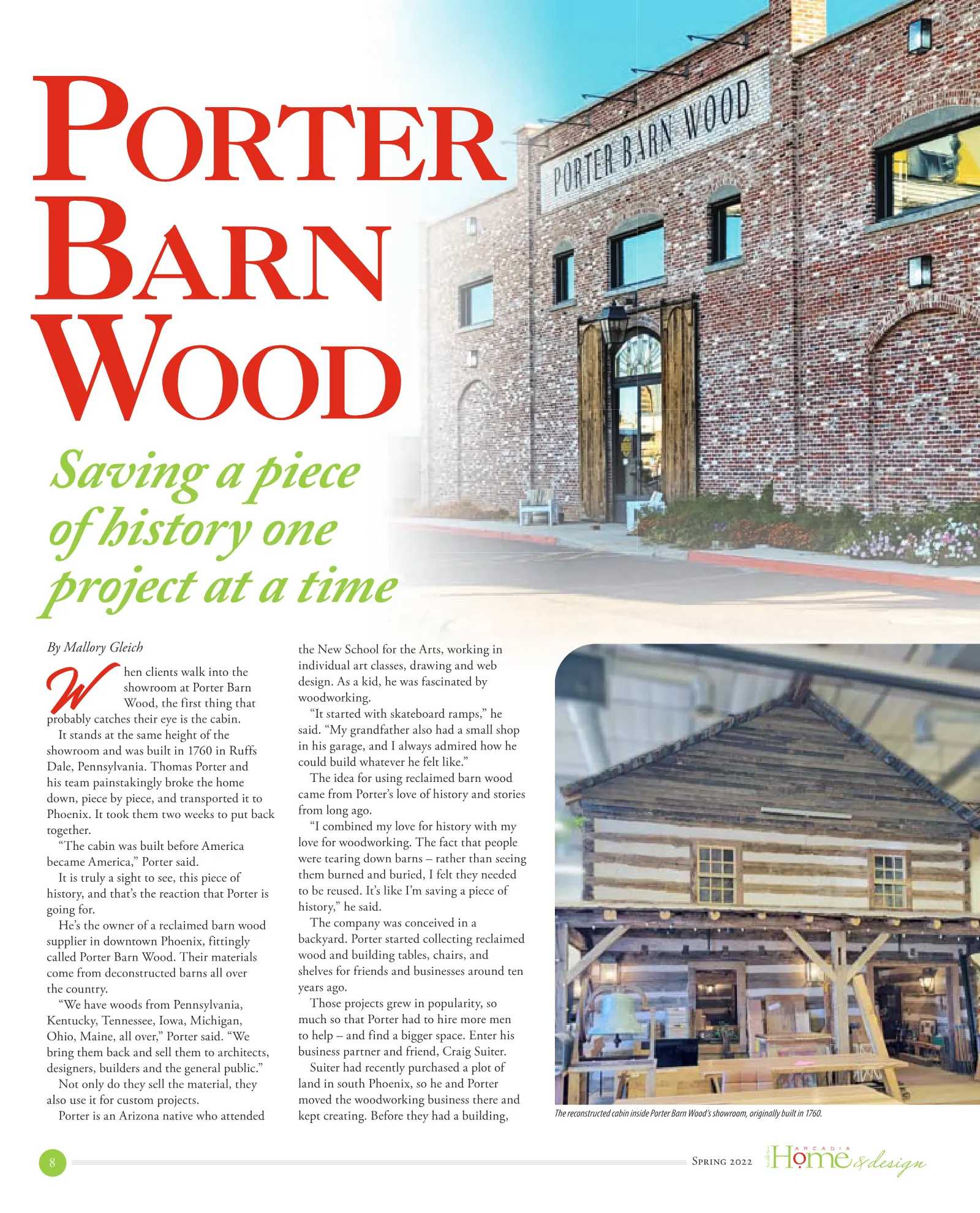
8 Spring 2022 By Mallory Gleich W hen clients walk into the showroom at Porter Barn Wood, the first thing that probably catches their eye is the cabin. It stands at the same height of the showroom and was built in 1760 in Ruffs Dale, Pennsylvania. Thomas Porter and his team painstakingly broke the home down, piece by piece, and transported it to Phoenix. It took them two weeks to put back together. “The cabin was built before America became America,” Porter said. It is truly a sight to see, this piece of history, and that’s the reaction that Porter is going for. He’s the owner of a reclaimed barn wood supplier in downtown Phoenix, fittingly called Porter Barn Wood. Their materials come from deconstructed barns all over the country. “We have woods from Pennsylvania, Kentucky, Tennessee, Iowa, Michigan, Ohio, Maine, all over,” Porter said. “We bring them back and sell them to architects, designers, builders and the general public.” Not only do they sell the material, they also use it for custom projects. Porter is an Arizona native who attended the New School for the Arts, working in individual art classes, drawing and web design. As a kid, he was fascinated by woodworking. “It started with skateboard ramps,” he said. “My grandfather also had a small shop in his garage, and I always admired how he could build whatever he felt like.” The idea for using reclaimed barn wood came from Porter’s love of history and stories from long ago. “I combined my love for history with my love for woodworking. The fact that people were tearing down barns – rather than seeing them burned and buried, I felt they needed to be reused. It’s like I’m saving a piece of history,” he said. The company was conceived in a backyard. Porter started collecting reclaimed wood and building tables, chairs, and shelves for friends and businesses around ten years ago. Those projects grew in popularity, so much so that Porter had to hire more men to help – and find a bigger space. Enter his business partner and friend, Craig Suiter. Suiter had recently purchased a plot of land in south Phoenix, so he and Porter moved the woodworking business there and kept creating. Before they had a building, Porter Barn Wood Saving a piece of history one project at a time The reconstructed cabin inside Porter Barn Wood’s showroom, originally built in 1760.
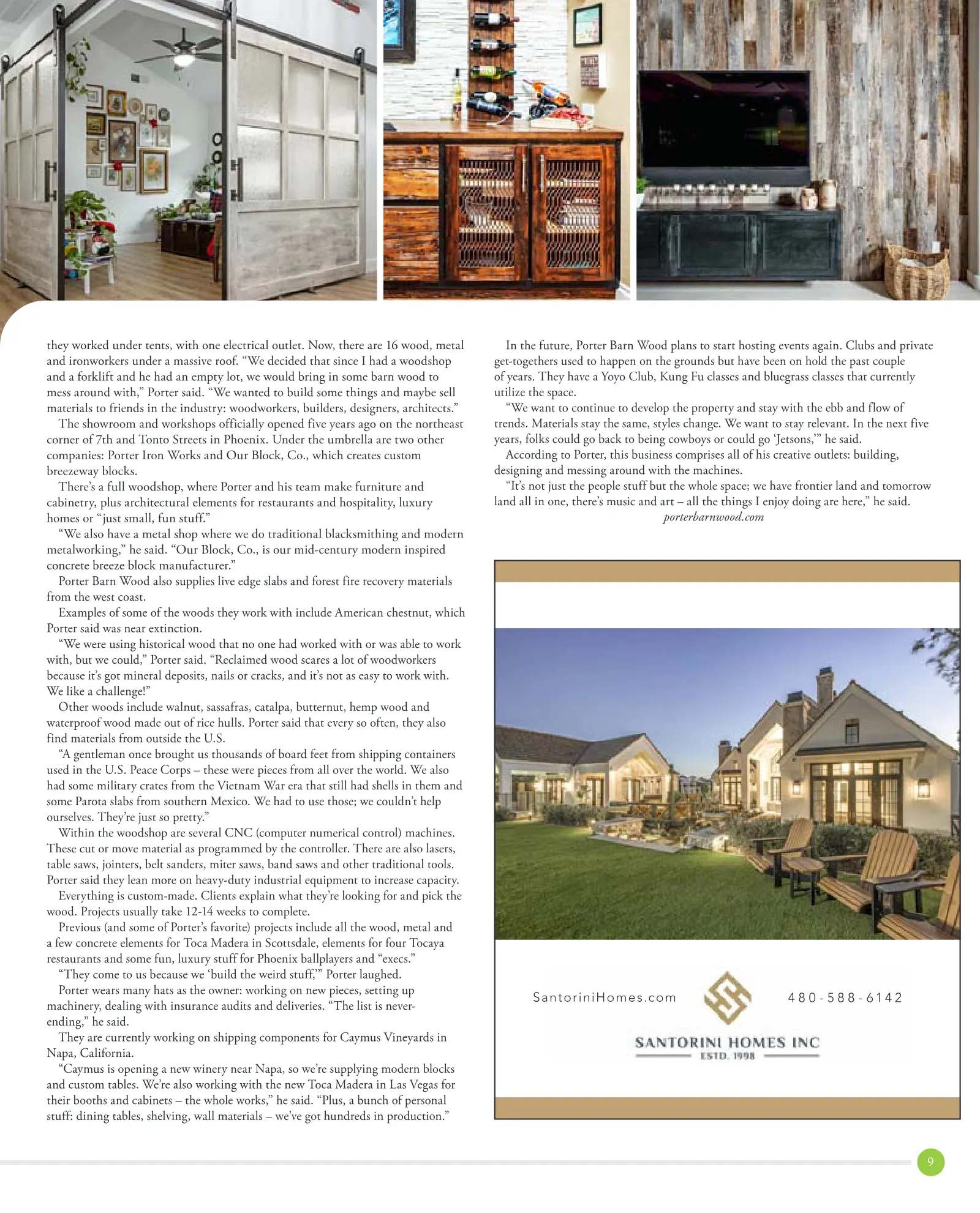
9 they worked under tents, with one electrical outlet. Now, there are 16 wood, metal and ironworkers under a massive roof. “We decided that since I had a woodshop and a forklift and he had an empty lot, we would bring in some barn wood to mess around with,” Porter said. “We wanted to build some things and maybe sell materials to friends in the industry: woodworkers, builders, designers, architects.” The showroom and workshops officially opened five years ago on the northeast corner of 7th and Tonto Streets in Phoenix. Under the umbrella are two other companies: Porter Iron Works and Our Block, Co., which creates custom breezeway blocks. There’s a full woodshop, where Porter and his team make furniture and cabinetry, plus architectural elements for restaurants and hospitality, luxury homes or “just small, fun stuff.” “We also have a metal shop where we do traditional blacksmithing and modern metalworking,” he said. “Our Block, Co., is our mid-century modern inspired concrete breeze block manufacturer.” Porter Barn Wood also supplies live edge slabs and forest fire recovery materials from the west coast. Examples of some of the woods they work with include American chestnut, which Porter said was near extinction. “We were using historical wood that no one had worked with or was able to work with, but we could,” Porter said. “Reclaimed wood scares a lot of woodworkers because it’s got mineral deposits, nails or cracks, and it’s not as easy to work with. We like a challenge!” Other woods include walnut, sassafras, catalpa, butternut, hemp wood and waterproof wood made out of rice hulls. Porter said that every so often, they also find materials from outside the U.S. “A gentleman once brought us thousands of board feet from shipping containers used in the U.S. Peace Corps – these were pieces from all over the world. We also had some military crates from the Vietnam War era that still had shells in them and some Parota slabs from southern Mexico. We had to use those; we couldn’t help ourselves. They’re just so pretty.” Within the woodshop are several CNC (computer numerical control) machines. These cut or move material as programmed by the controller. There are also lasers, table saws, jointers, belt sanders, miter saws, band saws and other traditional tools. Porter said they lean more on heavy-duty industrial equipment to increase capacity. Everything is custom-made. Clients explain what they’re looking for and pick the wood. Projects usually take 12-14 weeks to complete. Previous (and some of Porter’s favorite) projects include all the wood, metal and a few concrete elements for Toca Madera in Scottsdale, elements for four Tocaya restaurants and some fun, luxury stuff for Phoenix ballplayers and “execs.” “They come to us because we ‘build the weird stuff,’” Porter laughed. Porter wears many hats as the owner: working on new pieces, setting up machinery, dealing with insurance audits and deliveries. “The list is never- ending,” he said. They are currently working on shipping components for Caymus Vineyards in Napa, California. “Caymus is opening a new winery near Napa, so we’re supplying modern blocks and custom tables. We’re also working with the new Toca Madera in Las Vegas for their booths and cabinets – the whole works,” he said. “Plus, a bunch of personal stuff: dining tables, shelving, wall materials – we’ve got hundreds in production.” In the future, Porter Barn Wood plans to start hosting events again. Clubs and private get-togethers used to happen on the grounds but have been on hold the past couple of years. They have a Yoyo Club, Kung Fu classes and bluegrass classes that currently utilize the space. “We want to continue to develop the property and stay with the ebb and flow of trends. Materials stay the same, styles change. We want to stay relevant. In the next five years, folks could go back to being cowboys or could go ‘Jetsons,’” he said. According to Porter, this business comprises all of his creative outlets: building, designing and messing around with the machines. “It’s not just the people stuff but the whole space; we have frontier land and tomorrow land all in one, there’s music and art – all the things I enjoy doing are here,” he said. porterbarnwood.com S a n to r i n iH o m e s .c o m 4 8 0 - 5 8 8 - 6 1 4 2