
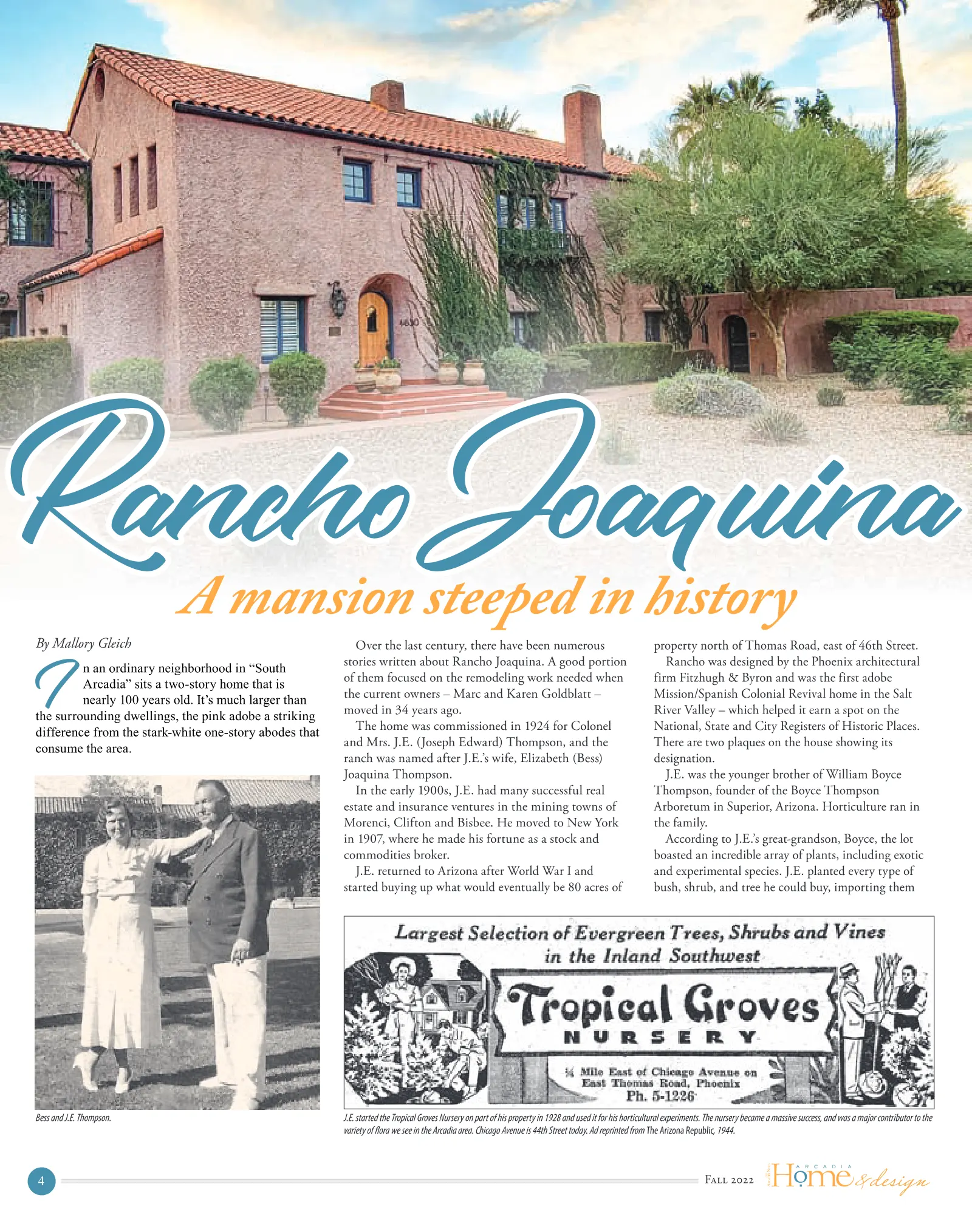
4 F RanchoJoaquina By Mallory Gleich I n an ordinary neighborhood in “South Arcadia” sits a two-story home that is nearly 100 years old. It’s much larger than the surrounding dwellings, the pink adobe a striking difference from the stark-white one-story abodes that consume the area. Over the last century, there have been numerous stories written about Rancho Joaquina. A good portion of them focused on the remodeling work needed when the current owners – Marc and Karen Goldblatt – moved in 34 years ago. The home was commissioned in 1924 for Colonel and Mrs. J.E. (Joseph Edward) Thompson, and the ranch was named after J.E.’s wife, Elizabeth (Bess) Joaquina Thompson. In the early 1900s, J.E. had many successful real estate and insurance ventures in the mining towns of Morenci, Clifton and Bisbee. He moved to New York in 1907, where he made his fortune as a stock and commodities broker. J.E. returned to Arizona after World War I and started buying up what would eventually be 80 acres of property north of Thomas Road, east of 46th Street. Rancho was designed by the Phoenix architectural firm Fitzhugh & Byron and was the first adobe Mission/Spanish Colonial Revival home in the Salt River Valley – which helped it earn a spot on the National, State and City Registers of Historic Places. There are two plaques on the house showing its designation. J.E. was the younger brother of William Boyce Thompson, founder of the Boyce Thompson Arboretum in Superior, Arizona. Horticulture ran in the family. According to J.E.’s great-grandson, Boyce, the lot boasted an incredible array of plants, including exotic and experimental species. J.E. planted every type of bush, shrub, and tree he could buy, importing them Bess and J.E. Thompson. J.E. started the Tropical Groves Nursery on part of his property in 1928 and used it for his horticultural experiments. The nursery became a massive success, and was a major contributor to the variety of flora we see in the Arcadia area. Chicago Avenue is 44th Street today. Ad reprinted from The Arizona Republic , 1944. A mansion steeped in history
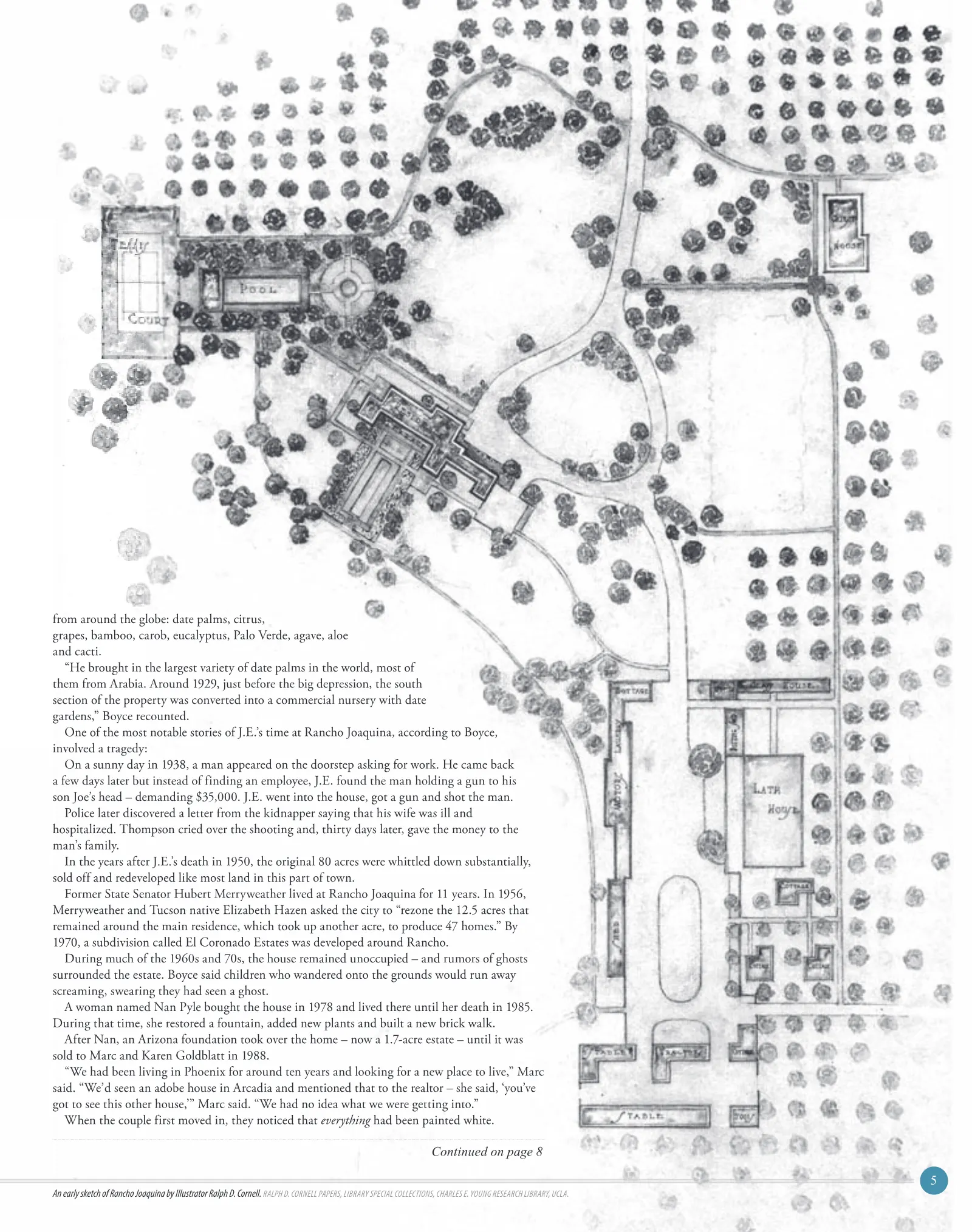
5 from around the globe: date palms, citrus, grapes, bamboo, carob, eucalyptus, Palo Verde, agave, aloe and cacti. “He brought in the largest variety of date palms in the world, most of them from Arabia. Around 1929, just before the big depression, the south section of the property was converted into a commercial nursery with date gardens,” Boyce recounted. One of the most notable stories of J.E.’s time at Rancho Joaquina, according to Boyce, involved a tragedy: On a sunny day in 1938, a man appeared on the doorstep asking for work. He came back a few days later but instead of finding an employee, J.E. found the man holding a gun to his son Joe’s head – demanding $35,000. J.E. went into the house, got a gun and shot the man. Police later discovered a letter from the kidnapper saying that his wife was ill and hospitalized. Thompson cried over the shooting and, thirty days later, gave the money to the man’s family. In the years after J.E.’s death in 1950, the original 80 acres were whittled down substantially, sold off and redeveloped like most land in this part of town. Former State Senator Hubert Merryweather lived at Rancho Joaquina for 11 years. In 1956, Merryweather and Tucson native Elizabeth Hazen asked the city to “rezone the 12.5 acres that remained around the main residence, which took up another acre, to produce 47 homes.” By 1970, a subdivision called El Coronado Estates was developed around Rancho. During much of the 1960s and 70s, the house remained unoccupied – and rumors of ghosts surrounded the estate. Boyce said children who wandered onto the grounds would run away screaming, swearing they had seen a ghost. A woman named Nan Pyle bought the house in 1978 and lived there until her death in 1985. During that time, she restored a fountain, added new plants and built a new brick walk. After Nan, an Arizona foundation took over the home – now a 1.7-acre estate – until it was sold to Marc and Karen Goldblatt in 1988. “We had been living in Phoenix for around ten years and looking for a new place to live,” Marc said. “We’d seen an adobe house in Arcadia and mentioned that to the realtor – she said, ‘you’ve got to see this other house,’” Marc said. “We had no idea what we were getting into.” When the couple first moved in, they noticed that everything had been painted white. An early sketch of Rancho Joaquina by Illustrator Ralph D. Cornell. RALPH D. CORNELL PAPERS, LIBRARY SPECIAL COLLECTIONS, CHARLES E. YOUNG RESEARCH LIBRARY, UCLA. Continued on page 8