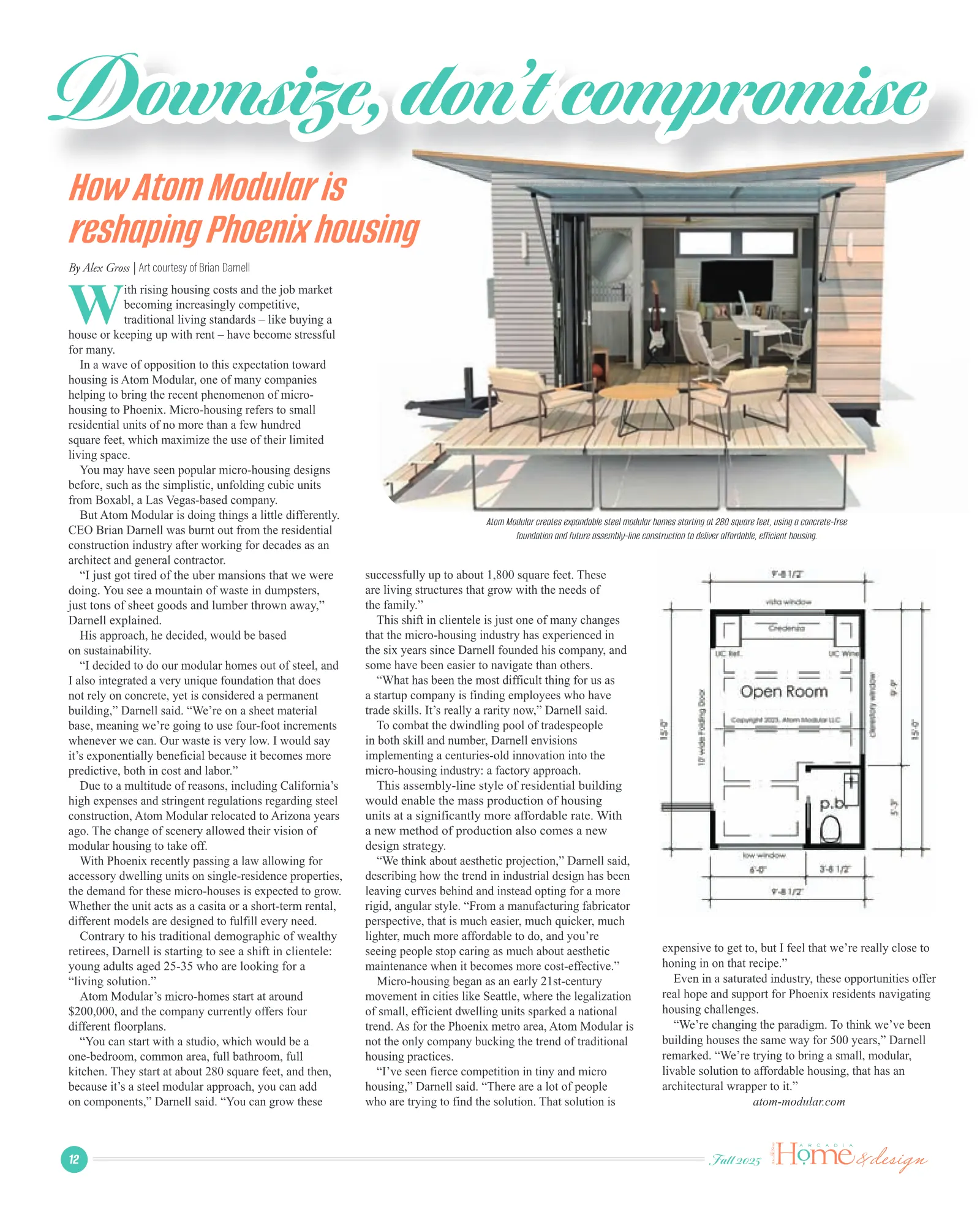

12 Fall 2025 By Alex Gross | Art courtesy of Brian Darnell W ith rising housing costs and the job market becoming increasingly competitive, traditional living standards – like buying a house or keeping up with rent – have become stressful for many. In a wave of opposition to this expectation toward housing is Atom Modular, one of many companies helping to bring the recent phenomenon of micro- housing to Phoenix. Micro-housing refers to small residential units of no more than a few hundred square feet, which maximize the use of their limited living space. You may have seen popular micro-housing designs before, such as the simplistic, unfolding cubic units from Boxabl, a Las Vegas-based company. But Atom Modular is doing things a little differently. CEO Brian Darnell was burnt out from the residential construction industry after working for decades as an architect and general contractor. “I just got tired of the uber mansions that we were doing. You see a mountain of waste in dumpsters, just tons of sheet goods and lumber thrown away,” Darnell explained. His approach, he decided, would be based on sustainability. “I decided to do our modular homes out of steel, and I also integrated a very unique foundation that does not rely on concrete, yet is considered a permanent building,” Darnell said. “We’re on a sheet material base, meaning we’re going to use four-foot increments whenever we can. Our waste is very low. I would say it’s exponentially beneficial because it becomes more predictive, both in cost and labor.” Due to a multitude of reasons, including California’s high expenses and stringent regulations regarding steel construction, Atom Modular relocated to Arizona years ago. The change of scenery allowed their vision of modular housing to take off. With Phoenix recently passing a law allowing for accessory dwelling units on single-residence properties, the demand for these micro-houses is expected to grow. Whether the unit acts as a casita or a short-term rental, different models are designed to fulfill every need. Contrary to his traditional demographic of wealthy retirees, Darnell is starting to see a shift in clientele: young adults aged 25-35 who are looking for a “living solution.” Atom Modular’s micro-homes start at around $200,000, and the company currently offers four different floorplans. “You can start with a studio, which would be a one-bedroom, common area, full bathroom, full kitchen. They start at about 280 square feet, and then, because it’s a steel modular approach, you can add on components,” Darnell said. “You can grow these successfully up to about 1,800 square feet. These are living structures that grow with the needs of the family.” This shift in clientele is just one of many changes that the micro-housing industry has experienced in the six years since Darnell founded his company, and some have been easier to navigate than others. “What has been the most difficult thing for us as a startup company is finding employees who have trade skills. It’s really a rarity now,” Darnell said. To combat the dwindling pool of tradespeople in both skill and number, Darnell envisions implementing a centuries-old innovation into the micro-housing industry: a factory approach. This assembly-line style of residential building would enable the mass production of housing units at a significantly more affordable rate. With a new method of production also comes a new design strategy. “We think about aesthetic projection,” Darnell said, describing how the trend in industrial design has been leaving curves behind and instead opting for a more rigid, angular style. “From a manufacturing fabricator perspective, that is much easier, much quicker, much lighter, much more affordable to do, and you’re seeing people stop caring as much about aesthetic maintenance when it becomes more cost-effective.” Micro-housing began as an early 21st-century movement in cities like Seattle, where the legalization of small, efficient dwelling units sparked a national trend. As for the Phoenix metro area, Atom Modular is not the only company bucking the trend of traditional housing practices. “I’ve seen fierce competition in tiny and micro housing,” Darnell said. “There are a lot of people who are trying to find the solution. That solution is expensive to get to, but I feel that we’re really close to honing in on that recipe.” Even in a saturated industry, these opportunities offer real hope and support for Phoenix residents navigating housing challenges. “We’re changing the paradigm. To think we’ve been building houses the same way for 500 years,” Darnell remarked. “We’re trying to bring a small, modular, livable solution to affordable housing, that has an architectural wrapper to it.” atom-modular.com Downsize, don’t ompromise How Atom Modular is reshaping Phoenix housing Atom Modular creates expandable steel modular homes starting at 280 square feet, using a concrete-free foundation and future assembly-line construction to deliver affordable, efficient housing.